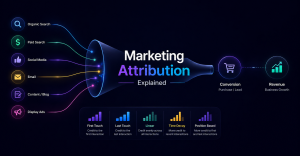


The Core Problem
Many businesses trust Google Analytics as their primary source of truth when it comes to marketing performance and revenue tracking. On the surface, it looks like a complete solution: traffic sources, conversions, reports — everything in one place.
But here’s the uncomfortable truth: Google Analytics was never designed to provide precise, business-critical revenue attribution.
It was built as a traffic analytics tool, not a revenue intelligence system.
That means it focuses on sessions, users, and events — not on reliably connecting the full journey from the first click to the final purchase. As your business grows and your marketing becomes more complex, this limitation becomes more and more expensive.
You start making decisions based on incomplete or misleading data.
Key Issues
One of the biggest problems is cross-device tracking. A user might click your ad on mobile, browse your site later on desktop, and finally make a purchase after returning directly. In this scenario, Google Analytics often attributes the conversion to the wrong source — or loses the original source entirely. What looked like “direct traffic” might actually be paid ads doing the work.
Another major issue is cookie limitations. Modern browsers, privacy updates, and ad blockers restrict tracking scripts. This means a significant portion of your users are either partially tracked or not tracked at all. The data you see in your reports is not just inaccurate — it’s incomplete.
Then there’s attribution bias. By default, most setups rely on last-click attribution. This model gives 100% credit to the final interaction before a conversion, ignoring all previous touchpoints. If a user first discovers you via a Facebook ad, then comes back via Google search, and finally converts through an email — only the last step gets credit.
This creates a distorted view of performance.
Channels that introduce users to your brand appear weak. Channels that close conversions appear stronger than they actually are.
Real Impact
These tracking issues are not just technical details — they directly affect your business decisions.
You might scale the wrong channel because it looks profitable in your reports, while in reality it’s just capturing conversions generated elsewhere. At the same time, you might reduce or completely stop campaigns that are actually driving high-quality traffic, simply because they don’t get proper attribution.
Over time, this leads to inefficient budget allocation, slower growth, and missed opportunities.
In some cases, businesses believe their marketing is not working at all, when in reality the problem is not performance — it’s visibility.
Better Approach
To fix this, you need to shift from third-party tracking to first-party data ownership.
Instead of relying entirely on external tools, you should capture and store key data inside your own system. This includes UTM parameters at the moment of the first visit, linking them to the user, and preserving that data throughout the entire journey — from visit to lead to purchase.
This approach allows you to:
- track the original source of every customer
- avoid data loss caused by cookies or browser restrictions
- build accurate revenue attribution across all channels
When you control your data, you stop guessing and start making decisions based on reality.
And that’s the point where marketing turns from a cost into a predictable growth engine.